Opinion Editorial August, 2026: Ethnic Unity of Village People
Opinion based on selected news stories from July 2026.
Ask someone "what creates ethnic unity?" and a likely answer will be "participating in a group singalong." That idea was used in July 1971 as the basis for one of the most iconic and successful TV commercials ever produced — the "Hilltop" commercial for Coca-Cola.
Traveling confirms the same principle. There are a few songs that are known and sung along to every day across the world. One of those songs is "Y.M.C.A." by the Village People. Victor Willis was the group's co-founder and original lead singer. His death was announced last month.
Ask any member of the Chinese Communist Party "what creates ethnic unity?" and the answer will be "the new law that came into effect last month [fifty-five years after the "Hilltop" commercial] because it mandates ethnic unity."
Like every other large country, China is a place of ethnic diversity. Many of its ethnic minorities are village people. Its new law has been widely criticized as a tool designed to erode ethnic minority rights there. It is at best a socio-political experiment doomed to eventual failure.
A socio-political experiment not (yet) doomed to eventual failure is American democracy. As it celebrated its 250th anniversary last month, a widely-held opinion is that it may not last a further 250 years. Last month, the Pew Research Center found that for the first time China is now viewed more favorably than America in many parts of the world. An opinion piece in The Guardian a few days ago discussed replacing the American-led world order.
"Take Me Home, Country Roads" is another song that is known and sung along to every day across the world. It was released in the same year as the "Hilltop" commercial. Fifty-five years later it became the unofficial American football team anthem at this year's World Cup. Yet despite the crowd singalongs, little unity was observed on the pitch during that event. Just two days ago the very future of the World Cup came into question when the Union of European Football Associations threatened to boycott it over international governance decisions made less than two weeks after this year's tournament ended.
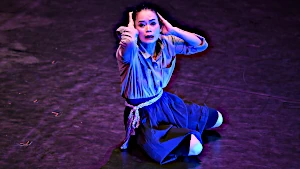
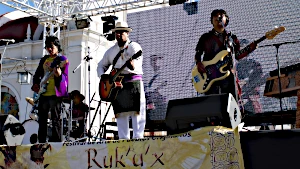
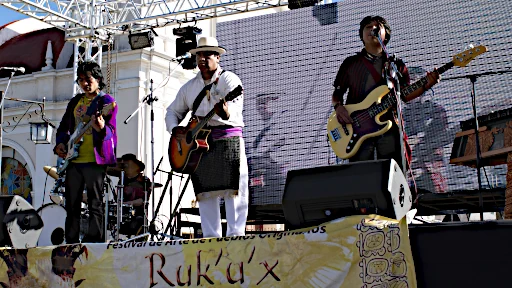
I observed ethnic unity first hand when I took this month's photo. I was at the Ruk'u'x indigenous art festival in central Guatemala. Although these musicians were not singing globally-known songs, they stirred a sense of unity among the ethnically diverse Mayan village people who were in the audience that day.
Musical flash mobs are another example of how group singalongs can stir a sense of ethnic unity. A YouTube video of a "Bohemian Rhapsody" flash mob (another one of those songs) has notched up forty million views in just ten months for that reason.
The "Hilltop" commercial has an ethnically diverse cast who sing "I'd like to teach the world to sing..." Gaia Music Collective has been doing exactly that since the COVID-19 pandemic. It mostly organizes one-day choirs. Participants at each event are typically a diverse range of people who never met before. Many report leaving with a sense of community fostered in the group.
Ethnic diversity can be exploited to create ethnic conflict. History is full of examples. One of those examples came just last month when a man known as "Illia K." was charged with criminal offenses in Poland. His purpose was allegedly to invoke historic tensions between Polish and Ukrainian peoples with the aim of usurping Polish support for Ukraine in its defense against Russian aggression.
Perhaps Illia K. and the Chinese Communist Party should watch 1971 TV re-runs, travel, attend a musical flash mob or sign up for a Gaia Music Collective event.
Our opinion editorials offer an indigenous peoples perspective on current world events. They do not link to external organizatons' websites; instead we encourage our readers to do their own research. If you would like to support our model of independent journalism, please click on the link or scan the QR code below to buy us a coffee. Thanks!